
How Accurate Are AI Image Detectors? Benchmarks Explained
By AI Detector 360 Editorial Team · · 6 min read
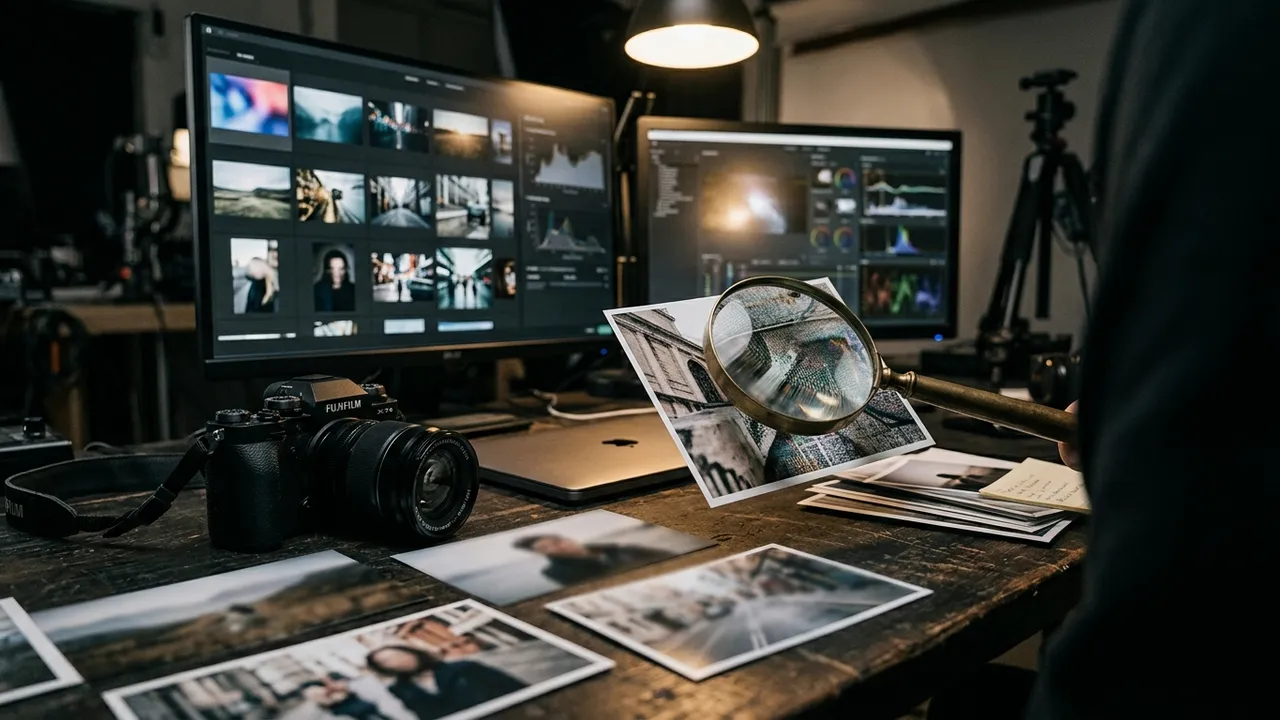
Every AI image detector advertises an accuracy number, and almost none of those numbers describe the images you'll actually check. Lab benchmarks use pristine, full-resolution files straight out of the generator. Your suspicious image is a compressed repost, cropped and re-saved three shares ago.
AI image detector accuracy ranges from above 95% on clean benchmark images to coin-flip territory on compressed or adversarially edited ones. The ARIA benchmark found most open-source detectors below 70%, with commercial tools swinging from excellent to terrible depending on generation mode — so any single accuracy claim without test conditions attached is marketing, not measurement.
Key takeaways
- Accuracy claims are meaningless without knowing the test set — clean lab images and compressed social reposts produce wildly different results.
- In the ARIA benchmark, most open-source detectors scored under 70% on AI images; some commercial tools dropped to 25–32% on image-plus-text generations.
- Bellingcat found a leading detector missed 7 of 10 AI images after social-media-level compression.
- Detectors stay useful when treated as one weighted signal alongside provenance and reverse search — not as a verdict machine.
What "accuracy" hides
A single accuracy percentage blends two very different mistakes. A false negative is an AI image waved through as real — embarrassing, but usually recoverable. A false positive is a real photo branded as fake, which can mean a photographer accused of fraud or a genuine war photo dismissed as propaganda. A detector tuned to catch more fakes flags more real photos, and vice versa; vendors choose where to sit on that curve and rarely tell you.
Base rates matter just as much. Run the arithmetic once and it sticks: screen 10,000 stock submissions where 20 are actually AI (1 in 500), with a tool that catches 95% of fakes at a 2% false-positive rate. You'll flag 19 real fakes — and about 200 innocent photos. Ten false alarms for every true catch, from a tool that sounds excellent on paper. The same tool pointed at a Midjourney-heavy Discord dump looks brilliant, because most flags there are correct. Nothing about the detector changed — only the pool. We walk through how we think about these trade-offs on our methodology page, because a detector that won't discuss its error profile is asking for blind trust.
What benchmarks say about AI image detector accuracy
The most instructive public test is the ARIA benchmark (Li et al., 2024), built from more than 140,000 real and generated images across five categories — artworks, social media images, news photos, disaster scenes, and anime — using four generators including Midjourney and DALL-E. Three findings stand out.
| Tested group | Result on ARIA |
|---|---|
| Humans, no reference images | 65.24% average accuracy |
| Humans, with reference examples | 68.00% |
| Humans on AI images specifically | 61.58% caught |
| Open-source detectors | Mostly below 70% on AI images |
| Best commercial tool, text-to-image samples | Above 95% |
| Several commercial tools, image+text samples | Dropped to 25–32% |
First: people are bad at this, which is why detectors exist at all. Second: the spread between commercial tools is enormous — the best cleared 95% on straightforward text-to-image samples while others barely functioned. Third, and least appreciated: generation mode matters. When images were generated from a text prompt plus a seed image (the way many real-world fakes are made, starting from an actual photo), several commercial detectors collapsed to 25–32%. The paper's blunt conclusion was that almost all detectors performed unsatisfactorily on those mixed-mode images.
A follow-up line of research made the gap explicit: an ICCV 2025 benchmark paper is devoted entirely to the distance between "ideal" evaluation and real-world conditions. The pattern repeats across the literature — detection is genuinely good in the lab and genuinely fragile in the wild.
Compression is the real-world killer
The single most consequential real-world condition is compression. When Bellingcat tested the detector AI or Not in September 2023, it identified all ten of their Midjourney test images correctly at full resolution. After compressing those images to 300–500 KB — roughly what a social platform does on upload — the detector called seven of the ten photorealistic fakes real.
That result is from 2023, but the physics hasn't changed: compression discards exactly the high-frequency detail where generation fingerprints live. Every reshare, screenshot, and platform re-encode strips more signal. By the time an image has bounced from a generator through a messaging app to a news feed, the pixel evidence is partly destroyed — no vendor has repealed that, whatever the marketing page says.
Why not just train detectors on compressed images, then? Vendors do, and it helps — but it's a trade, not a fix. Compression erases some fingerprints outright, and training a model to call weaker evidence "AI" also teaches it to flag more real photos whose textures happen to resemble that weakened signal. You can shift the errors around the curve; you can't recover information that JPEG threw away. The practical consequence for you: the same image can score 95% as an original file and 55% as a WhatsApp forward, and the second number isn't the tool malfunctioning — it's the tool honestly reporting thinner evidence.
Is that image AI-generated?
Upload a picture and get classifier scores, provenance (C2PA/EXIF) checks and likely-generator attribution.
Try the AI image detectorWhy lab numbers keep going stale
Even on uncompressed images, accuracy decays over time for a structural reason: detectors are trained on the output of existing generators, and generators keep changing. A model that learned the noise fingerprint of 2024-era diffusion pipelines meets a 2026 release with different upsampling and different artifacts. Until retraining catches up, accuracy quietly sags — while the published benchmark number, measured against the old generators, stays frozen on the pricing page.
Add ordinary user behavior — crops, filters, upscalers, "enhance" buttons — and each edit nudges the statistics further from what the detector expects. None of this makes detection worthless. It makes point-in-time, single-number accuracy claims worthless. What matters is whether a tool degrades gracefully: does it tell you when its evidence is thin?
Using an imperfect detector well
Here's the honest playbook we recommend, and build around:
- Feed it the best copy you can find. Hunt for the original upload before scanning; our reverse image search workflow shows how. A first-generation file carries far more signal than a fourth-generation repost.
- Read confidence, not just score. The AI Detector 360 image detector reports a probability with an explicit confidence level, and low-quality inputs are labeled as such rather than scored with false precision.
- Stack independent evidence. Pixel statistics are one leg. Provenance is another — a scan here also inspects C2PA Content Credentials, EXIF traces and generation parameters embedded in the file. Visual inspection is the third; the manual signs of AI images still catch things models miss.
- Use attribution as a sanity check. Our reports include likely-generator attribution, since different generators leave different tells. An image that scores "AI, low confidence" but carries a Firefly manifest is a solved case; one that scores 55% with no provenance is an honest unknown.
Five questions for any accuracy claim
When a vendor (including us) shows you a number, these questions separate measurement from marketing — AI Detector 360's own answers live on the methodology page linked above, where anyone can audit them:
- Measured on what test set, built when? A 2024 test set says nothing about 2026 generators.
- Which generators and generation modes? ARIA showed image-plus-text generations can crater tools that ace pure text-to-image.
- Were compressed and resized copies included? If the answer is silence, assume the number is lab-only.
- What's the false-positive rate at that threshold? "99% detection" is trivial if you accept flagging a third of real photos.
- Does the tool report confidence per scan? A system that won't say "low confidence" is hiding its weakest results inside its average.
Anyone selling a 99% flat accuracy claim for AI image detection in 2026 is quoting a lab condition you will never encounter. We'd rather tell you where the floor is and give you the tools to stand on it: multiple signals, stated confidence, and reports that admit uncertainty. That's what separates a measurement from a magic 8-ball.
Is that image AI-generated?
Upload a picture and get classifier scores, provenance (C2PA/EXIF) checks and likely-generator attribution.
Try the AI image detectorFrequently asked questions
Which AI image detector is the most accurate?
There's no stable answer, and rankings shuffle every time a new image model ships. In the ARIA benchmark one commercial tool exceeded 95% on pure text-to-image samples while others fell to 25–32% on image-plus-text generations. Judge tools by how they behave on your kind of images — compressed, cropped, real-world files — and whether they disclose confidence, not by a headline number.
Can a screenshot fool an AI image detector?
It can degrade one significantly. Screenshotting re-renders the image, discards all metadata, and adds a fresh layer of encoding — wiping provenance evidence and dampening the statistical traces detectors rely on. Detection on screenshots isn't hopeless, but expect lower confidence, and never treat a clean score on a screenshot as strong evidence.
Is a 90% AI score proof that an image is fake?
No. It means the detector found patterns that, in its training data, appeared far more often in generated images. Depending on the tool's false-positive rate and how rare AI images are in your context, a 90% score can still be wrong often enough to matter. Use it as one strong input alongside provenance, reverse search and visual inspection.
Do accuracy numbers cover brand-new generators like the latest Midjourney or Gemini models?
Usually not at first. Benchmarks are snapshots of the generators available when the test set was built, and detectors typically lag new architectures until they're retrained. That's a structural reason to distrust "99% accurate" marketing — the number was measured against yesterday's generators, and your suspicious image may come from today's.
Sources & further reading
Fair-use note: AI detection scores — from any tool, including ours — are probabilistic estimates, not proof. Never make academic, employment or legal decisions on a score alone.
Related reading
Reverse Image Search + AI Detection: Verify Any Image's Origin
A three-step workflow to check if an image is AI: reverse image search for origin, provenance metadata for receipts, and an AI detector for the pixels.
Sep 21, 2026 · 6 min read
Midjourney vs. Real Photos: What Still Gives AI Images Away
Midjourney's photorealism fools most eyes in 2026. How to tell Midjourney images from real photos: the signature look, lighting tells and detector strategy.
Sep 11, 2026 · 6 min read
What Are C2PA Content Credentials? Provenance Explained Simply
What is C2PA? A plain-English guide to Content Credentials: how signed provenance manifests work, who embeds them in 2026, and why absence proves nothing.
Aug 14, 2026 · 6 min read