
Midjourney vs. Real Photos: What Still Gives AI Images Away
By AI Detector 360 Editorial Team · · 6 min read
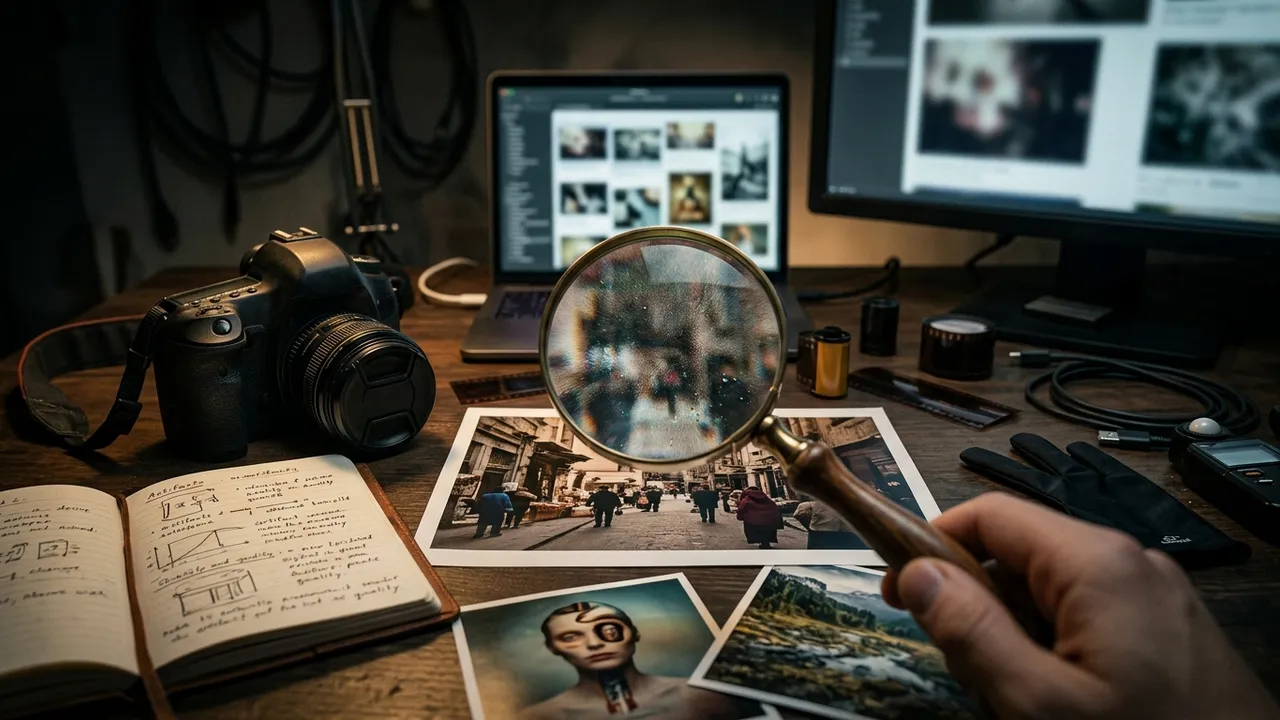
Midjourney didn't just get photorealistic; it got tastefully photorealistic. That's precisely what makes its images hard to catch — and, once you know the taste, what makes them catchable. The tells that survive in 2026 aren't errors so much as habits.
To tell Midjourney images from real photos, look past the subject and interrogate the style: cinematic lighting no real scene would produce, texture that's uniformly polished, backgrounds that dissolve under attention, and a total absence of provenance metadata. Then confirm with a detector, because the pixel-level fingerprints outlast every cosmetic improvement.
Key takeaways
- Midjourney's real signature is aesthetic: idealized light, cinematic grading and flattering composition applied to everything.
- Anatomy tells (hands, teeth) are mostly fixed; physics tells (shadows, reflections, focus geometry) still hold.
- Midjourney embeds no C2PA metadata and no watermark, so file inspection can never confirm or clear it.
- Detectors read statistical fingerprints that survive model updates — but lose accuracy on compressed reposts.
The "Midjourney look," explained
Every generator has a house style, and Midjourney's is the most recognizable in the industry: warm rim light, gentle haze, shallow depth of field, colors graded like a streaming drama, subjects rendered at their most photogenic angle. The model was tuned on community upvotes for years, and the result is a system that doesn't imitate photography so much as it imitates award-winning photography, all the time, regardless of subject.
That's the first and broadest tell. Real photos — even good ones — contain compromise: harsh noon sun, cluttered corners, a lamppost growing out of someone's head, mixed color temperatures from a window and a bulb. When an allegedly candid image has the light, styling and composition of a $50,000 commercial shoot, ask why. A "street photo" where every stranger is attractive and the golden hour lasts forever is a render until proven otherwise.
The look can be prompted away, of course — "amateur iPhone photo, harsh flash" produces convincingly ugly output. But most users don't fight the defaults, so the aesthetic remains the most common first flag in the wild.
How to tell Midjourney images from real photos
Once the vibe check raises suspicion, three concrete layers separate renders from captures.
Light that flatters instead of obeys
Midjourney lights scenes for beauty, not consistency. Trace the shadows: multiple subjects lit from different directions, faces conveniently illuminated with no visible source, reflections in windows or eyes that don't reconstruct the visible scene. Real light is an accounting system — everything must balance. Rendered light is a mood.
Texture with no history
Real surfaces record wear: scuffed shoes, uneven skin, dust on shelves, fabric that wrinkles where bodies bend it. Midjourney textures are detailed but ahistorical — pores and threads present, but distributed with statistical evenness, like a material sample rather than a lived-in object. Grain is the giveaway at high zoom: real sensor noise clusters in shadows; rendered "grain" sits uniformly across the frame.
Scenes that don't hold up
Attention decays with distance from the subject. Background crowds share limbs, shelving merges, secondary signage drifts into almost-letters even when foreground text is clean. Chains of logic fail too — a café with cups but no saucers, bicycles locked to nothing, stairs that couldn't connect their floors. Our general guide to spotting AI-generated images covers these physics and coherence checks in full; they apply to every generator, Midjourney included.
| Trait | Real photo | Midjourney tendency |
|---|---|---|
| Lighting | One consistent source system, often unflattering | Cinematic, sourceless, always flattering |
| Skin and surfaces | Uneven, asymmetric, worn | Uniformly polished detail |
| Backgrounds | Cluttered but coherent | Clean but logically soft |
| Grain | Concentrated in shadows | Even across the frame |
| Composition | Compromised by reality | Centered, styled, idealized |
| Metadata | Camera EXIF common | Nothing at all |
Is that image AI-generated?
Upload a picture and get classifier scores, provenance (C2PA/EXIF) checks and likely-generator attribution.
Try the AI image detectorWhy metadata won't save you here
With DALL-E, Firefly or Google's image models, a file-level check can end the investigation: those tools embed C2PA Content Credentials that name the generator. Midjourney embeds nothing — no manifest, no invisible watermark, not even IPTC source fields. A suspected Midjourney image with clean metadata is therefore the expected case, not evidence of innocence.
The flip side matters too: a present camera EXIF block isn't strong proof of authenticity, since EXIF is trivially editable and gets attached to renders by people laundering them. This asymmetry — signed provenance is hard to fake but easy to strip, plain metadata is easy to fake and easy to strip — is exactly why Content Credentials only work as a positive signal. For Midjourney specifically, the file tells you nothing; the pixels and the context have to do all the work.
Laundering is worth understanding because it's how most Midjourney fakes actually travel. The render gets screenshotted (killing any residual traces), passed through a phone filter or a grain overlay (mimicking camera character), sometimes stamped with borrowed EXIF, then posted as "shot on my walk this morning." Each step is trivial, and each step is also detectable as a step — a supposed straight-from-camera photo with screenshot dimensions, no lens metadata and Instagram-filter tone curves has a story that doesn't add up. Inconsistency between the claimed origin and the file's actual state is a tell of its own.
What detectors see that eyes can't
Midjourney was one of the four generators used to build the ARIA benchmark (140,000+ images), where human participants caught only 61.58% of AI images. Detectors read a different layer than humans do: frequency-domain artifacts, upsampling fingerprints, noise distributions characteristic of the diffusion pipeline. Those fingerprints persist across version updates that fix hands and teeth, which is why detection keeps working after each "this changes everything" release.
Two honest caveats. First, compression: Bellingcat's well-known 2023 test showed a leading detector missing 7 of 10 Midjourney images after they were compressed to social-media size — the fingerprints live in fine detail, and re-encoding erodes them. Second, no detector is uniformly strong across generators and modes; we've broken down the benchmark numbers in our guide to AI image detector accuracy.
This is where generator attribution earns its keep. The AI Detector 360 image detector doesn't just score AI likelihood — it reports which generator family the image most resembles, with an explicit confidence level. "Likely AI, consistent with Midjourney" plus the aesthetic tells above plus no provenance is a converging case. You can run a first pass in the browser with our free AI detector before deciding whether a deeper report is worth it.
One nuance on attribution scores: they're softer evidence than the plain AI-versus-real call, and we label them accordingly. Generator families share techniques and train on overlapping data, so "consistent with Midjourney" sometimes really means "consistent with this generation of diffusion models." Where attribution shines is direction — it tells you which community to search, which watermark scheme won't be present, and which visual tells to double-check.
The 30-second Midjourney triage
Condensing all of the above into the check you'll actually run on a suspicious "photo":
- Vibe (5 sec). Does reality ever look this art-directed? If the light is cinematic and every element flatters, raise the flag.
- Zoom (10 sec). Skin and grain at high magnification: uniform polish and even noise say render; blotches and shadow-heavy grain say sensor.
- Context (10 sec). Reverse-search it. Prompt feeds and AI art accounts end the question; a 2019 news wire copy ends it the other way.
- Scan (5 sec to start). Upload to AI Detector 360 for detection plus attribution, and let the statistical layer weigh in while you re-read the caption's claims.
Midjourney will keep getting better, and this page will keep needing updates — that's the honest state of the arms race. What doesn't change is the method: style skepticism first, physics second, provenance context third, statistical detection last. Stack them, and even 2026's best renders have a hard time surviving all four.
Is that image AI-generated?
Upload a picture and get classifier scores, provenance (C2PA/EXIF) checks and likely-generator attribution.
Try the AI image detectorFrequently asked questions
Can Midjourney images really pass for photographs?
Routinely. With photography-style prompts (lens, film stock, lighting terms), current Midjourney versions produce portraits and street scenes that most viewers accept as photos — in the ARIA study, people caught only about 62% of AI images even when told to look. The failures now hide in physics and fine texture, not in obvious anatomy mistakes.
Does Midjourney add a watermark or label to its images?
No. Midjourney downloads carry no visible watermark, no invisible watermark and no C2PA Content Credentials — unlike DALL-E, Firefly or Google's image models. That's why a metadata check can confirm those other generators but can never clear or convict a suspected Midjourney image.
What's the fastest reliable check for a suspected Midjourney image?
Reverse image search first — many viral "photos" turn out to be documented Midjourney posts on the creator's own feed. If that's inconclusive, scan it with a detector that offers generator attribution and check the lighting and background logic yourself. Two of three signals agreeing is a solid basis for judgment.
Did Midjourney V7 remove all the old tells?
It fixed most anatomy problems — hands, teeth, eyes — and improved text rendering, but it didn't change the deeper signature: idealized lighting, uniformly polished texture and backgrounds that decay under scrutiny. Model updates consistently erase the checklist tells while leaving the statistical fingerprints detectors read largely intact.
Sources & further reading
Fair-use note: AI detection scores — from any tool, including ours — are probabilistic estimates, not proof. Never make academic, employment or legal decisions on a score alone.
Related reading
What Are C2PA Content Credentials? Provenance Explained Simply
What is C2PA? A plain-English guide to Content Credentials: how signed provenance manifests work, who embeds them in 2026, and why absence proves nothing.
Aug 14, 2026 · 6 min read
How Accurate Are AI Image Detectors? Benchmarks Explained
AI image detector accuracy looks great in labs and shaky on real feeds. What the ARIA benchmark and Bellingcat's compression test reveal about real scores.
Jul 31, 2026 · 6 min read
How to Tell If an Image Is AI-Generated: 9 Signs + Free Tools
The obvious tells are fading. How to tell if an image is AI generated in 2026: lighting physics, texture patterns, C2PA metadata checks and detector tools.
Jul 6, 2026 · 8 min read