
How We Test AI Detectors: Our Evaluation Methodology
By AI Detector 360 Editorial Team · · 5 min read
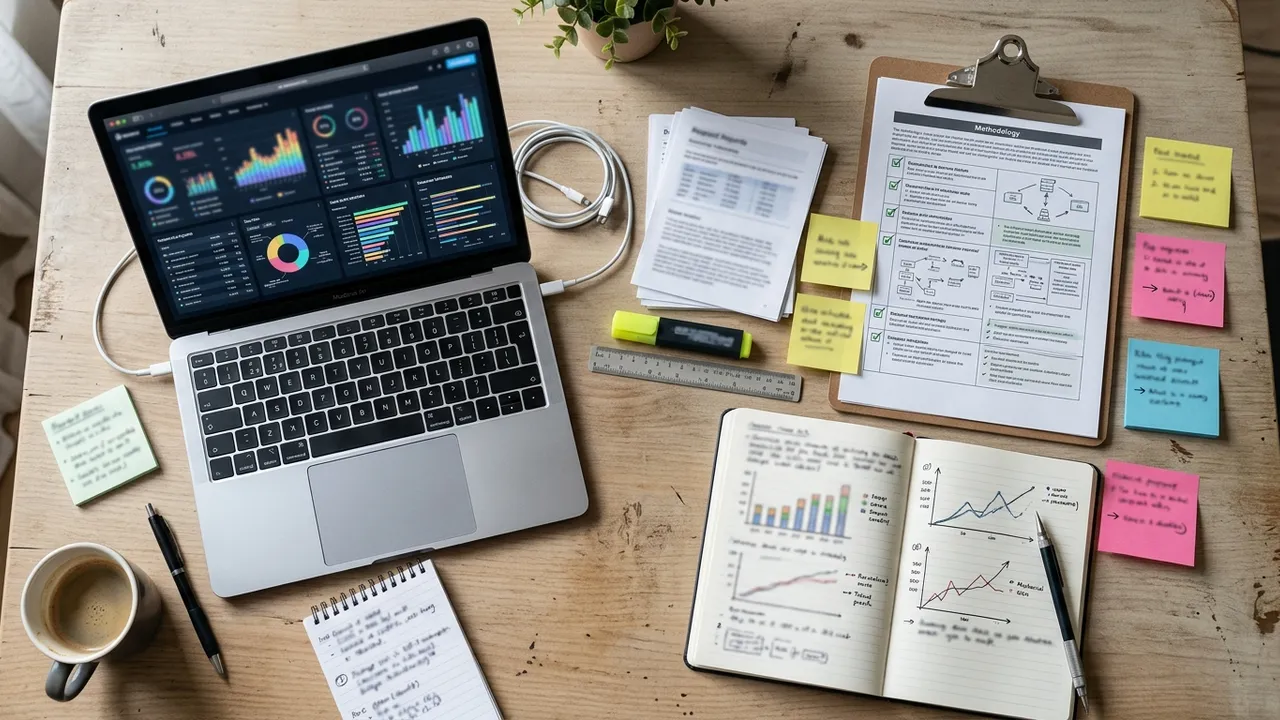
Every detector we review on this blog, including our own, gets run through the same wringer, and this page documents it. Publishing the methodology matters because we're not neutral: we build AI Detector 360, and reviews from a vendor are worth exactly as much as the process behind them is transparent. Here's the process.
We test AI detectors against five balanced sample sets (verified human writing, pure AI output, mixed drafts, paraphrased AI text and non-native English writing) and report detection rates at a fixed false-positive rate rather than a single accuracy number. The design borrows deliberately from the academic RAID benchmark, and our own tool gets no exemptions.
Key takeaways
- A raw accuracy percentage is close to meaningless without knowing the false-positive rate it was measured at.
- Our corpus covers five text types because detectors fail differently on each, especially non-native English writing.
- We borrow RAID's core ideas: fixed false-positive rates, adversarial paraphrasing and domain variety.
- AI Detector 360 runs through the identical protocol, and when a competitor wins a category, we say so in the review.
Why a raw accuracy number tells you almost nothing
Imagine a test set of 90 AI texts and 10 human ones. A detector that flags everything scores 90% accuracy while falsely accusing every human in the sample. That arithmetic is why vendor claims of 98% or 99.98% can be technically true and practically useless: accuracy depends entirely on the mix of the test set and the threshold chosen for the marketing page.
The market's track record makes the point for us. Copyleaks claims 99.1% accuracy at a 0.2% false-positive rate; independent tests have measured 77 to 96%. Winston AI claims 99.98%; independent results run 76 to 92%. ZeroGPT advertises 98%; 2026 testing put it near 74%. And OpenAI, with every incentive to succeed, retired its own AI text classifier in July 2023 after it caught just 26% of AI text while false-flagging 9% of human writing. None of these companies is necessarily lying. They're measuring on friendly terrain, which is precisely why independent context on detector accuracy matters more than any banner statistic.
Our AI detector testing methodology, step by step
Every evaluation starts from the same five sample sets, refreshed as models change:
- Verified human writing. Text that provably predates modern generators (pre-2022 archives, published books) plus recent writing whose authorship we can vouch for directly. This set exists to measure false positives, nothing else.
- Pure AI output. Text from multiple current model families and older generations, produced with varied prompts and sampling settings, because detection difficulty shifts with both the model and how it's run.
- Mixed drafts. AI drafts edited by humans, and human drafts polished by AI. Most real-world text in 2026 lives here, and detectors disagree with each other most violently on it.
- Paraphrased and "humanized" AI text. The same AI passages pushed through paraphrasing tools, since evasion is the most common adversarial condition a detector faces.
- Non-native English writing. A dedicated human-written set, because the failure mode is documented and ugly: a 2023 Stanford study in Patterns found detectors flagged an average of 61.3% of TOEFL essays by non-native speakers as AI, and that bias deserves its own measurement, not a footnote.
Each sample also carries a length label, because scores on short text are structurally unstable; we exclude anything under 150 words from headline numbers and test short text separately, for reasons covered in how much text detectors need.
The metrics we actually report
The headline metric is detection rate at a fixed false-positive rate: we set each tool's threshold so it wrongly flags at most 1% (and separately 5%) of the verified-human set, then measure how much AI text it catches at that setting. This is the only way to compare tools that ship with different default aggressiveness. Alongside it we report per-set breakdowns (a tool that's strong on pure AI text but collapses on paraphrases gets described exactly that way), score stability across repeated runs, and how honestly a tool communicates uncertainty: whether it exposes confidence bands or hides a coin flip behind a confident-looking percentage.
Check any text for AI — free
Paste up to 5,000 characters into our free scanner, no sign-up. Full multi-engine reports with sentence heatmaps start at $0.
Try the free AI detectorWhat we borrowed from RAID
The RAID benchmark (Dugan et al., ACL 2024, University of Pennsylvania) is the closest thing this field has to a shared measuring stick: over 10 million documents spanning multiple generators, domains, decoding strategies and 12 adversarial attacks, all evaluated at controlled false-positive rates. Three of its design choices shaped ours. Fixing the false-positive rate before comparing anything. Treating paraphrase and character-level attacks as core test conditions rather than edge cases, since commercial detectors degraded sharply under both. And publishing the recipe, so results can be argued with. We're a small editorial operation, not an academic lab, and our corpora are smaller; where our numbers and RAID's disagree, take RAID's.
How we handle our own tool
AI Detector 360 goes through the same five sets, the same fixed-FPR thresholds, the same re-runs. Two policies keep us honest. First, published comparisons name the categories where competitors beat us, which is why our reviews credit GPTZero's free tier, Copyleaks' LMS integrations and Winston's OCR on the record; you can check that promise against our free detector roundup. Second, our product philosophy matches the methodology: our scanner attaches an explicit confidence level to every score because we test exactly how wrong scores can be. The full product-side detail lives on our methodology page. A detection score is evidence, never proof, and we build and review accordingly.
The limits of any testing, including ours
Honest caveats, in order of importance. Our verified-human set can't cover every writing style, dialect or field, so false-positive rates in your context may differ from ours. Models drift: a review from six months ago describes a different detector than the one running today, which is why every review carries verification dates. Sample sizes bound precision; small gaps between tools are noise, and we say so rather than manufacture a ranking. And human judgment still matters: research presented at ACL 2025 found expert human annotators reached 99.3% accuracy identifying AI text, which is a standing reminder that tools assist judgment rather than replace it.
If you evaluate detectors yourself, steal all of this. Fix the false-positive rate first, test the text types you actually deal with, and write down the date.
Check any text for AI — free
Paste up to 5,000 characters into our free scanner, no sign-up. Full multi-engine reports with sentence heatmaps start at $0.
Try the free AI detectorFrequently asked questions
What is a false-positive rate in AI detection testing?
It's the share of genuinely human-written texts a detector wrongly flags as AI. A tool with a 5% false-positive rate accuses one innocent writer in twenty. Because accusations carry real costs, serious evaluations fix this rate first, then measure how much AI text a detector catches at that setting.
Why do vendor accuracy claims differ so much from independent tests?
Vendors test on data they choose, often the content types their model handles best, and report results at thresholds that flatter the headline number. Independent tests use unfamiliar data, mixed genres and adversarial edits. Both numbers can be technically true; only one predicts real-world behavior.
What is the RAID benchmark?
RAID is a public benchmark for AI text detectors from University of Pennsylvania researchers, presented at ACL 2024. It spans more than 10 million documents across models, domains, decoding settings and 12 adversarial attacks, and it evaluates detectors at controlled false-positive rates so results are comparable.
How often should AI detector reviews be updated?
Whenever the ground shifts, which in this market is every few months. New model releases change what AI text looks like, and vendors retrain and reprice constantly. Date-stamp every claim you rely on, and distrust reviews that don't say when their numbers were last verified.
Sources & further reading
Fair-use note: AI detection scores — from any tool, including ours — are probabilistic estimates, not proof. Never make academic, employment or legal decisions on a score alone.
Related reading

The 7 Best Free AI Detectors in 2026 (Honestly Compared)
The best free AI detectors in 2026, honestly compared: real word limits, sign-up rules, and accuracy caveats for GPTZero, ZeroGPT, QuillBot and more.
Jul 6, 2026 · 6 min read
How Much Text Do AI Detectors Need to Be Reliable?
AI detectors get sharply less reliable below ~150 words. Here's the minimum text you need for a trustworthy AI detection score, and why short text misleads.
Sep 4, 2026 · 5 min read
How Accurate Are AI Detectors in 2026? What Studies Actually Show
How accurate are AI detectors in 2026? What independent studies from Stanford, UPenn and NBER actually found — and how to vet any vendor's accuracy claim.
Jul 6, 2026 · 6 min read